
Living Alone Safely
I Live Alone. What Happens If Something Happens to Me?
September 1, 2026 · The Alrightly Team
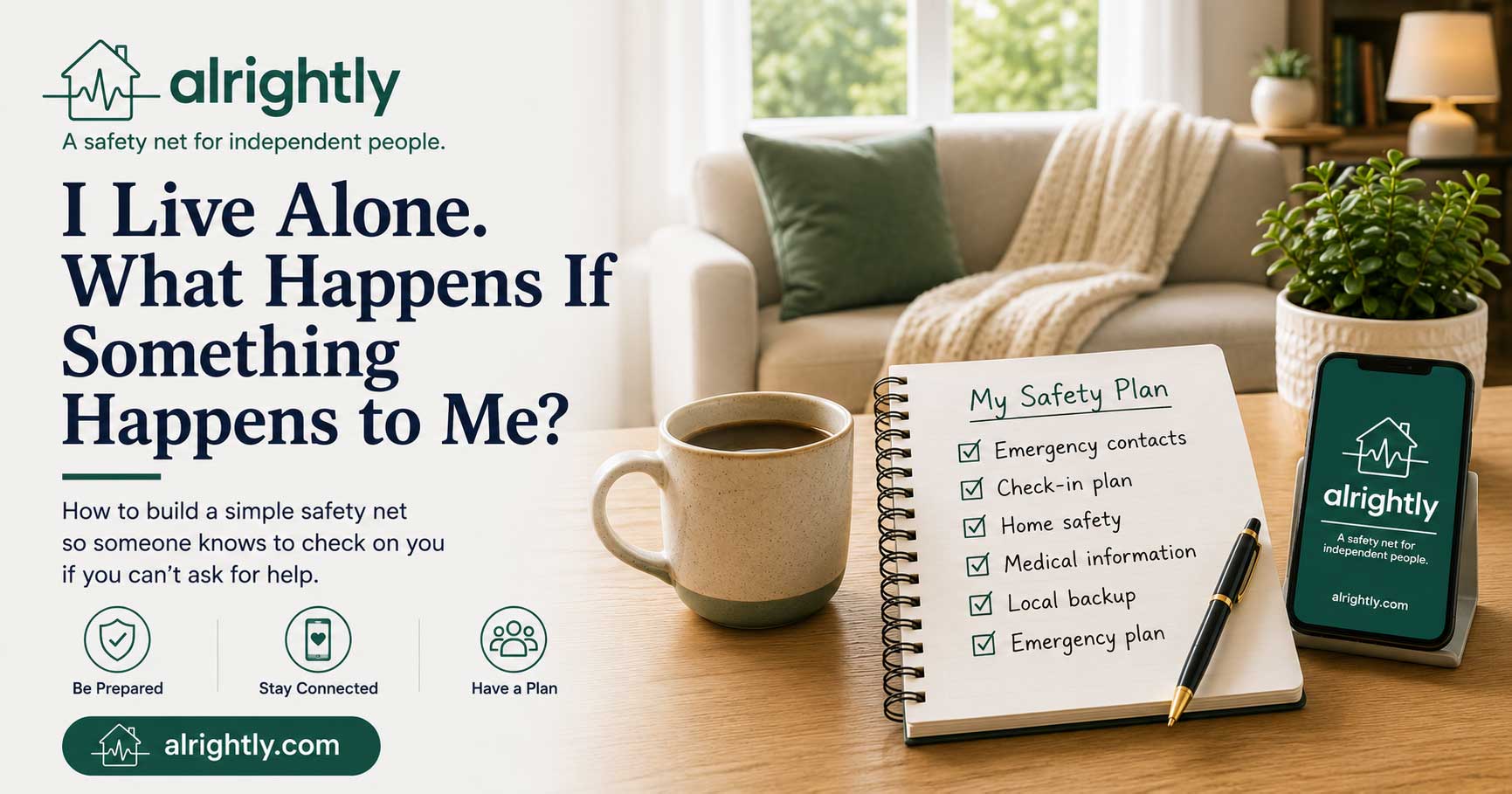
If you live alone, you may have had this thought at some point: What if something happens to me and nobody knows?
Maybe it crossed your mind after you slipped on the stairs. Maybe you got unusually sick one night and realized there wasn't anyone else in the house. Perhaps you heard about someone who had an emergency at home and wasn't found for some time. Or maybe nothing prompted it at all. It's simply one of those practical questions that can come with living by yourself.
The concern is understandable, but it doesn't mean living alone is unsafe or that you need someone monitoring you. It does reveal something worth planning for. When you live with another person, their presence creates a safety mechanism you may barely notice. If your normal routine suddenly changes, someone is likely to notice.
When you live alone, you may need to create that mechanism intentionally. The goal isn't to give up independence. It's to make sure that if you couldn't tell anyone you needed help, something else would eventually tell them that they should check on you.
The Problem Isn't Always Calling for Help
Most emergency advice assumes you'll know that something is wrong and be able to respond. If there's a fire, call 911. If you're seriously injured, call 911. If you become very ill, seek medical help. That's good advice. If you're experiencing an immediate or potentially life-threatening emergency, call 911 or your local emergency number whenever you're able to do so.
There's another category of emergency that's especially relevant when you live alone: What happens when you can't make the call? You could:
Lose consciousness
Fall and be unable to reach your phone
Become suddenly confused or disoriented
Have a serious medical event while sleeping
Become too weak or injured to get help
Experience an accident that leaves you unable to communicate
Those aren't pleasant possibilities to think about, but they aren't reasons to become afraid of living alone. They're simply situations your emergency plan should account for. The important distinction is that some emergencies require you to actively ask for help, while others may leave you unable to do that.
The Detection Gap: How Long Until Someone Notices?
Here's a useful way to think about the problem. Imagine something happens at 9 p.m. tonight and you're unable to use your phone. At what point tomorrow would another person realize something wasn't right?
For some people, the answer is early the next morning. For others, it might be that evening. For someone who works remotely, lives far from family, doesn't have regularly scheduled commitments, and usually communicates with friends only occasionally, it could potentially be several days.
We can call that period the detection gap:
The detection gap is the time between becoming unable to ask for help and someone else realizing that you may need it.
When you live with someone, that gap may naturally be short. When you live alone, it depends heavily on your routines and relationships. That also means you can shorten it deliberately.
Related reading: Living Alone Safety Checklist: 20 Things Everyone Who Lives Alone Should Have in Place
Start by Figuring Out Your Current Detection Gap
You can get a useful sense of your current detection gap with a quick thought experiment. Imagine that, beginning right now, you couldn't:
Answer your phone
Send a text
Go outside
Show up somewhere
Tell anyone you needed help
Who would notice first, and when? Maybe your employer would notice tomorrow morning. Maybe your sister would become concerned if you didn't respond to her text tonight. Maybe you meet a friend every Tuesday, but today is Wednesday. A neighbor might eventually notice that your car hadn't moved, or perhaps nobody has a predictable reason to expect contact from you for several days.
There's no judgment attached to the answer. Some independent people simply have routines that don't involve daily contact with other people. The point is to understand where your gap currently exists and then decide whether you're comfortable with it.
Don't Rely on Someone "Eventually Noticing"
Many of us have informal safety nets without realizing it. You text your mother most days, a friend sends you memes, your coworker expects you online in the morning, or your neighbor sees you walking your dog. Those connections are valuable, but they aren't necessarily an emergency plan.
Suppose you don't text your friend tomorrow. Would your friend think, Something may be wrong. I should check on her? Or would she think, She's probably busy? Most likely, she'd assume the second, and that's perfectly reasonable.
People miss texts. Plans change. Phones die. People sleep late, take spontaneous trips, get absorbed in projects, or simply don't feel like talking. That's why regular contact isn't automatically the same thing as a check-in system. A safety system needs some point at which silence changes meaning.
Related reading: Living Alone Doesn't Mean You're Alone
Create a Clear Signal
One of the simplest ways to shorten the detection gap is to establish a predictable signal. For example, you might tell someone:
"I'll check in by 10 a.m. each day. If I haven't checked in by noon and you can't reach me, please make sure I'm okay."
Now your contact doesn't have to guess whether your silence means anything. There is a defined expectation. This can be as simple as a daily text, scheduled phone call, message in a family group chat, check-in with a neighbor, or automated safety check-in.
The important part isn't the technology. It's that absence becomes meaningful. Instead of relying on someone to eventually wonder why they haven't heard from you, you've established a point at which your silence means, "Please pay attention."
Build a Safety Net With More Than One Layer
No single safety measure covers every situation. A better approach is to create several simple layers that complement one another, so your entire plan doesn't depend on one person, device, or method working perfectly.
Layer 1: Your Phone
Your smartphone is probably your first way of getting help. Learn how its emergency features work and make sure you've configured the ones you want. Depending on your device, these may include Emergency SOS, emergency contacts, medical information accessible from the lock screen, location sharing during an emergency, or crash-detection features.
Don't wait until an emergency to learn how to activate them. Spend a few minutes understanding what your phone can do and making sure the people and information you've designated are still current.
Layer 2: A Trusted Person
Choose someone who knows what you want them to do if they can't reach you. That could be a family member, friend, neighbor, coworker, or another person you trust.
Ideally, don't merely list someone as an "emergency contact." Talk to them. Make sure they know you've chosen them, what circumstances should concern them, and what you'd want them to do if they thought something might be wrong.
Layer 3: Someone Local
Your primary contact doesn't necessarily need to live nearby, but if they don't, identify someone who does. Imagine your sister lives six hours away and realizes you've missed a check-in. She knows something may be wrong, but she can't simply stop by your house.
A trusted neighbor, nearby friend, relative, building manager, or other local contact may be able to determine quickly whether you simply left your phone on silent or whether something is actually wrong. Your distant contact and local contact can serve different roles within the same safety net.
Layer 4: A Defined Check-In
Establish something that creates a predictable indication that you're okay. It could be human or automated. What's important is that a missed check-in has an agreed meaning.
A defined check-in also removes some of the guesswork from ordinary communication. Your friend doesn't need to interpret every unanswered text as potentially significant. The check-in is the signal you've both agreed matters.
Layer 5: Emergency Services
Your personal safety net doesn't replace emergency services. If you're able to call for help during a potentially life-threatening emergency, call 911 or your local emergency number rather than waiting for a friend, family member, neighbor, or check-in system to respond.
These layers aren't alternatives to one another. They complement each other. Your phone may help you actively call for assistance, while a defined check-in can provide backup for a situation in which you're unable to make that call yourself.
What If I Don't Want Someone Checking on Me Every Day?
Then don't ask someone to check on you every day. This is where safety and surveillance sometimes get unnecessarily mixed together.
Living alone doesn't mean someone needs to know:
Where you are
What you're doing
When you leave home
When you return
Who you're with
Whether you've followed your normal routine all day
You may not want that level of visibility, and you don't need to provide it simply because you want a safety net. You may only want a mechanism that communicates Everything is normal. No action needed. If that expected signal doesn't happen, the message changes to Something might be wrong. Please check.
A safety check-in system can be built around exactly this distinction. You confirm that you're okay at an agreed interval, and your trusted contacts only need to become involved if the expected check-in doesn't happen. That's very different from asking someone to watch you.
If that approach sounds closer to the kind of safety net you want, our guide to what a safety check-in app is and how it works explains the concept in more detail.
What About Location Tracking?
Location sharing can be extremely useful. It can also provide more information than you want to share continuously. There isn't one correct choice. Some people like having a family member or friend able to see their location, while others strongly prefer that nobody can track where they go. Both are reasonable.
The better question is what problem you're actually trying to solve. If your concern is "I want someone to be able to find me when I'm hiking alone," location sharing may be extremely useful. If your concern is "I want someone to know if I've had an emergency at home," continuous location tracking may not be necessary.
Some safety systems use location information, while others don't require continuous location tracking at all. Before choosing one, understand what information it collects and shares. The best safety system is one that solves the problem you actually have and that you're comfortable enough to keep using.
What About a Medical Alert System?
Medical alert systems can be an excellent choice for some people, particularly when a known risk makes immediate access to help important. Depending on the system, features can include:
Wearable help buttons
Fall detection
Two-way communication
Professional monitoring
GPS
Automatic emergency response
Not everyone who lives alone needs or wants a medical alert device, however. If you're a healthy 35-, 50-, or 65-year-old who simply wants somebody to notice if your normal routine unexpectedly stops, a different type of safety net may fit better.
This is another reason not to treat "living alone safety" as synonymous with "senior safety." The underlying problem—how someone will know if you need help and can't ask for it—exists across age groups. The right tool depends on your circumstances rather than your age alone.
What About a Smartwatch?
A smartwatch can add another useful layer, particularly because it's more likely to remain physically accessible than a phone sitting across the room. Depending on the model and configuration, features may include emergency calling, fall detection, crash detection, location sharing, and medical information.
The limitation is the same one that applies to any device: no technology covers every scenario. A smartwatch may not be worn, its battery may be dead, fall detection may not recognize every fall, or you may experience an emergency that doesn't involve a fall.
That's why it's useful to think in layers rather than searching for one device that solves everything. A smartwatch can be part of a strong safety net without needing to be the entire safety net.
Your Emergency Contact Needs a Plan Too
Imagine you've established a daily check-in. Tomorrow you miss it, so your contact tries calling you. There's no answer. Now what? If the answer is "I don't know," your safety net still has a gap.
Talk through a basic escalation plan with your contact. For example:
Step 1: Call and text me.
Step 2: Wait an agreed amount of time, depending on the circumstances.
Step 3: Contact my local backup person.
Step 4: If there's reason to believe I'm in immediate danger, contact emergency services.
Your plan may be different, and that's fine. The important thing is that the person receiving the alert understands what it means and knows what you would like them to do next. An alert becomes much more useful when it comes with a plan.
Make Sure Someone Can Actually Reach You
There's another easily overlooked problem. Suppose your friend knows you're inside your home and may need help, but your door is locked. Who has a key, and how would someone actually get to you?
Depending on your living situation, options could include:
A trusted neighbor with a spare key
A nearby friend or relative
A secure lockbox
A smart lock with appropriate emergency access
A building manager or superintendent
Think about both notification and access when creating your safety plan. Knowing that something may be wrong is useful, but that knowledge doesn't necessarily help if nobody can reach you. Make sure at least one part of your plan addresses what happens after someone realizes you may need assistance.
If You Have Pets, Include Them in the Plan
For people who live alone with pets, there can be a second concern hiding inside the first one: If something happens to me, what happens to them? If you're unexpectedly hospitalized or otherwise unable to return home, someone needs to know that your pets are there and may need care.
Your safety contact should ideally know:
What pets you have
Where they are
Who can access your home
Where food and supplies are stored
Whether they take medication
Who your veterinarian is
Who could care for them temporarily
This doesn't require an elaborate pet emergency plan. At minimum, make sure someone you trust knows your pets are in the home, can figure out how to reach them, and knows whom to contact if you'll be away for more than a short time. A simple written note with feeding instructions, medications, veterinary information, and a backup caregiver can make an unexpected situation much easier to manage.
Your Safety Net Can Change When Your Risk Changes
You don't need the same level of backup every day of your life. Your normal routine might call for one daily check-in, for example, while recovering from outpatient surgery might make morning and evening contact with someone more appropriate for a few days.
The same principle applies to other temporary changes. If you're sick with the flu and live alone, you might ask a friend to check on you that evening. If you're taking a solo road trip, you might temporarily share your location with someone. If you're climbing a ladder to clean your gutters, you might text your neighbor beforehand and let them know when you're finished.
Think of your safety net as adjustable. Most days, it can remain almost invisible in the background of your life. When circumstances temporarily increase your risk, you can strengthen it. When things return to normal, you can scale it back.
That's independence with a backup plan—not supervision.
How Automated Check-Ins Can Close the Detection Gap
There's a weakness in asking another person to remember to check on you: they have to remember too. Imagine you and your sister agree that she'll text you every morning. Eventually she's going to have a hectic morning, go on vacation, get distracted by something happening in her own life, or simply assume you're busy. That's human.
An automated check-in reverses the responsibility. Instead of requiring another person to remember to initiate the check-in every day, the system establishes an expected signal from you:
You have a defined check-in schedule.
You confirm you're okay.
Nothing happens when you check in normally.
If you don't check in, the system can notify the people you've chosen.
That's the idea behind Alrightly. It isn't intended to have someone watch your life or require another person to continually check up on you. It's designed to create a backup for the moment when your normal signal unexpectedly disappears.
This approach also addresses the detection gap differently from an ordinary call or text routine. Most of the time, checking in should be uneventful. Nobody needs to wonder where you are or what you're doing. The missed check-in is what changes the situation from ordinary silence into a signal that someone may need to pay attention.
The important question isn't which technology sounds most sophisticated. It's whether your system reliably answers a much more practical question: Who notices when I can't tell anyone myself?
A Five-Minute Exercise You Can Do Right Now
You don't need to overhaul your life to answer that question. Take five minutes and work through these five prompts. The goal is to understand the safety net you already have and identify any gaps that you actually want to change.
1. If I became unable to communicate right now, who would notice first?
Write down the person's name. Think about who would realistically notice rather than simply naming the person you're closest to.
2. Approximately how long would it take them to notice?
Would it be a few hours, a day, or several days? That gives you an estimate of your current detection gap.
3. Would that person know what to do?
If the answer is no, you may not need a new piece of technology. You may simply need a conversation about what you'd want them to do if they couldn't reach you.
4. Is there someone nearby who could physically check on me?
Your closest friend or relative may live hundreds of miles away. If your main contact isn't local, consider identifying a nearby friend, neighbor, relative, or other trusted person who could serve as a local backup.
5. What could shorten the gap without interfering with how I want to live?
It might be a daily text, a regular check-in with a friend, your phone's emergency features, a smartwatch, or an automated check-in. Your existing system might already be exactly what you want. The goal isn't to add technology or create more anxiety; it's to replace a vague worry with a plan that fits your life.
Living Alone Isn't the Problem
There's an important difference between thinking, I live alone, so nobody is looking after me, and thinking, I live independently, and I have a safety net if I need it. The second doesn't require giving someone constant access to your life or asking another person to take responsibility for you.
You don't need to be watched to be connected. You don't need someone calling three times a day to remain safe, and you don't need to give up your privacy because you live alone. You simply need to decide what you want to happen if, one day, the normal signs that you're okay suddenly aren't there.
That's a problem you can plan for. Once you've planned for it, the question "What if something happens to me?" becomes a little easier to answer: Someone will know what to do.
Related reading: I Love Living Alone. I Just Want Someone to Know If Something Happens.